Home    Multimedia   Follow:  subscribe Subscribe   Library Connect News via RSS RSS   Become a Fan on Facebook Facebook   Follow us on Twitter Twitter   Share:      Delicious  Delicious
Library Connect, Partnering with the Library Community. www.elsevier.com/libraryconnect


search this site search web
 View PDF    Browse archives
Community Connections: The ScienceDirect High School Program: Participants report excellent results
<<  First   |  <  Previous   |   Next  >  |   Last >>
Community Connections
The ScienceDirect High School Program:
Participants report excellent results

By Rochelle L. Gore, Director of Sales, North America/Global Account Sales, Elsevier, New York, NY, USA

The ScienceDirect High School Program, founded in 1999, provides schools with low-cost access to the database and continues to draw favorable feedback from participants. More than 70 schools across the US are now participating in the program. Schools in the UK have also expressed interest in the program, and so it has recently been opened to schools throughout Europe.

ScienceDirect

The program benefits students and teaching staff. By accessing ScienceDirect, students gain exposure to the same scientific knowledge available to the world’s leading science researchers. Hence students can expand the scope of their research projects and become better prepared for the collegiate research experience. Teaching staff at participating schools also gain from their access to ScienceDirect’s current content, offering information especially useful in the science classroom and laboratory.

Participating schools must meet several requirements. The material in the ScienceDirect database is accessible free of charge to participants, though an annual maintenance fee of USD $500 is charged for the setup to connect each participating institution to the database. Additionally, Elsevier encourages each school to follow the Science Service (www.sciserv.org) research guidelines, including those covering the use of animals and human subjects.

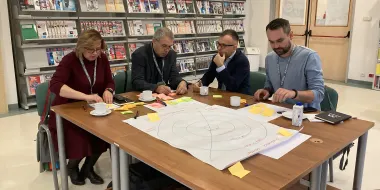
Harker School science student Sabrina Paseman is trying to design a spectrophotometer to measure blood iron levels without drawing blood. Such a noninvasive device could be helpful in treating iron deficiency disorders and other nutrient deficiency disorders. Here Sabrina (seated) uses ScienceDirect to research current spectrophotometer technology. Looking at her findings in the database are (standing, left to right) Library Director Enid Davis, classmate Rahul Ahuja and teacher Dr. Ben Abrams.
Harker School science student Sabrina Paseman is trying to design a
spectrophotometer to measure blood iron levels without drawing
blood. Such a noninvasive device could be helpful in treating iron
deficiency disorders and other nutrient deficiency disorders. Here
Sabrina (seated) uses ScienceDirect to research current
spectrophotometer technology. Looking at her findings in the database
are (standing, left to right) Library Director Enid Davis, classmate Rahul
Ahuja and teacher Dr. Ben Abrams.

What New York participants say

Four years ago, through the program, we introduced ScienceDirect to some of New York City’s leading high schools. Included were Bronx High School of Science and Stuyvesant High School, whose students have included finalists in the prestigious Intel Science Talent Search. Students, teachers and librarians at participating New York schools have written to Elsevier colleagues and expressed appreciation for the program.

Arlene Morales, a library media specialist at Midwood High School in Brooklyn, wrote: "We started using Elsevier in the spring of 2007. The quality of information available from Elsevier was extremely valuable and academically superior to any databases we had at that time. I would say that it has raised the academic performance bar on our students' learning experience and improved their quality of research in the sciences.”

“Though I can’t prove a direct connection between our students’ success and our access to ScienceDirect, I can say that everyone here loves ScienceDirect.”

Andrew Girgis, now a student at St. Francis Xavier Secondary School in Canada, used ScienceDirect while at the Bronx High School of Science in 2007. He wrote: “I really don't know how to thank you. The database is so useful that the head of my school's science department wants to implement ScienceDirect as the major research tool for his IB [international baccalaureate] students as soon as possible. Some of my classmates are already in desperate need of it for their articles.”

What a California librarian says

At the Harker School in the middle of Silicon Valley, Library Director Enid Davis has observed firsthand how students and faculty benefit from the school’s participation in the program.

She said, “For advanced students, there’s nothing close to ScienceDirect, and it helps our science teachers at all levels. Science teachers say it certainly has enhanced the quality of research information available to students. Providing access to the database helps educate students in how to use scholarly databases. We’ve participated in the ScienceDirect High School Program since 2006, and in 2007, for the second year in a row, we had three semifinalists in the Intel Science Talent Search competition. Though I can’t prove a direct connection between our students’ success and our access to ScienceDirect, I can say that everyone here loves ScienceDirect.”

Bringing it all together

Historically, when we look at all participating schools, we see that ScienceDirect is most frequently used in honors and advanced placement classes in the junior and senior years. Though we don’t have formal evaluation guidelines, participating schools’ annual renewal rate is close to 100%.

Participation in the program is by request. Anyone interested can contact me at r.gore@elsevier.com. end of article

www.sciencedirect.com

Resources

Back to Top